It is 4:15pm on a Thursday. A woman has just left a fender-bender with a stiff neck, calling law firms from an urgent care parking lot. Your line rings. Whoever picks up has about 90 seconds to make her feel heard and get her booked before she scrolls to the next name. Most firms lose her right there, not because their lawyers are worse, but because nobody had a plan for the call.
Here is the plan. Below are word-for-word intake scripts for five practice areas, the follow-up texts that turn “let me think about it” into a booked consult, the two lines that keep you out of trouble (the conflict check and the no-advice line), and the compliance rules for your follow-up. Steal all of it. Tape the relevant page next to the phone, and your next caller gets a better call than most of your competitors will give theirs.
Key Takeaways
- Only 40% of firms answer the phone when a prospect calls, down from 56% in 2019, and 64% of callers get no follow-up at all (Clio 2024 Legal Trends Report). A script plus a follow-up cadence beats most of your market before you say a word about the case.
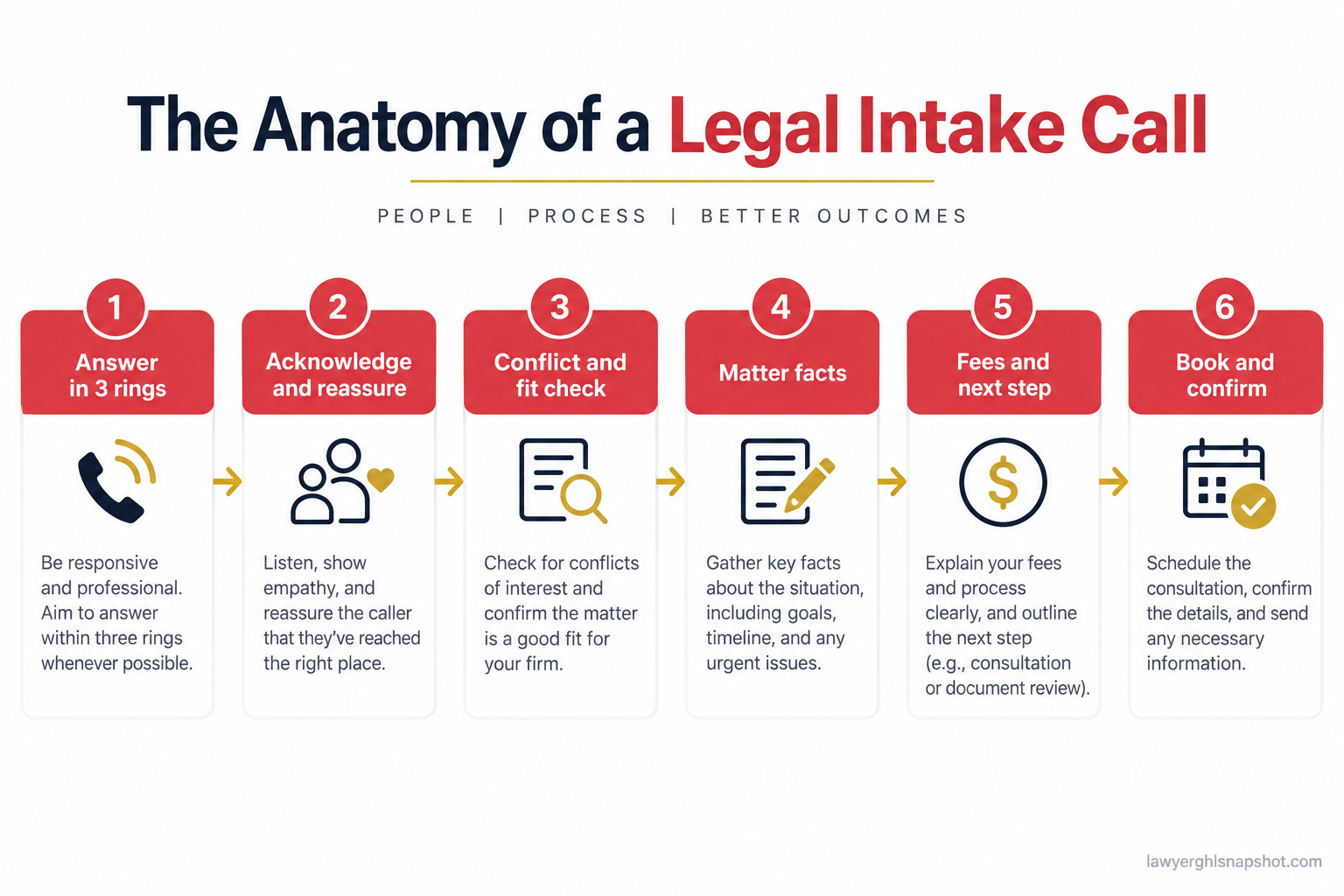
- A great intake call has six stages, in order: answer fast, acknowledge, run a conflict and fit check, get the matter facts, handle fees and the next step, then book and confirm. The words change by practice area; the structure does not.
- The scripts below are practice-area specific (personal injury, family, criminal defense, estate planning, immigration) because the first three questions that matter are different for each.
- Two lines protect you every time: the conflict-check question and the “we cannot give legal advice on this call” line. Say both, every call.
- Your follow-up has legal limits. Marketing texts need prior express written consent under the TCPA, and any AI or chatbot handling intake must disclose it is not a lawyer and route, not advise.
Table of contents
- What a fumbled intake call actually costs
- The six stages of a great intake call
- The universal intake script (any practice area)
- Intake scripts by practice area
- The follow-up scripts that book the consult
- Run the script for a solo, a small team, and a 15-attorney firm
- How intake calls break, and how to fix each one
- The compliance lines you cannot skip
- Common objections
- FAQ
What does a fumbled intake call actually cost?
Start with the number that stings. In Clio’s 2024 secret-shopper study of 500 firms, only 40% answered the phone, down from 56% in 2019, and 64% of prospective clients got no follow-up at all (Clio 2024 Legal Trends Report). Nearly two thirds of the people trying to hire a lawyer heard nothing back.
Speed decides the rest. Contact a lead within five minutes instead of thirty and you are 100 times more likely to reach them and 21 times more likely to qualify them (InsideSales / MIT Lead Response study); a separate audit of 2,241 companies found 23% never responded at all (Harvard Business Review). Legal buyers do not wait; they call the next firm.
That dropped caller is a client you already paid to acquire. And the lawyer who does answer captures just 3.0 billable hours in an 8-hour day (38% utilization), at 88% realization and 93% collection (Clio benchmarks). A tight script protects both the lead and the hour.
Law firm responsiveness, percent. Source: Clio 2024 Legal Trends Report secret-shopper study of 500 U.S. firms.
What are the six stages of a great intake call?
Every good intake call runs the same six stages, whatever the practice area. Miss one and the call wobbles:
- Answer fast and warm. Pick up inside three rings, with a real greeting.
- Acknowledge and reassure. Name their situation back before you ask anything.
- Conflict and fit check. Get the opposing party’s name and matter type early.
- Matter facts. Gather the two or three details that decide whether this is a case.
- Fees and the next step. Say how you charge in plain terms, then book.
- Book and confirm. Put a specific time on the calendar and confirm it by text.
The universal intake script
Read it aloud a few times so it sounds like you. Bracketed parts are yours to fill in.
That no-advice line is not a formality: opining on the merits risks the unauthorized practice of law.
The close offers two specific times, not “would you like to schedule?” An open-ended question invites “let me think”; two times invite a choice.
Intake call scripts by practice area
The structure above never changes. What changes is stage 4, the two or three questions that determine whether there is a case and how urgent it is.
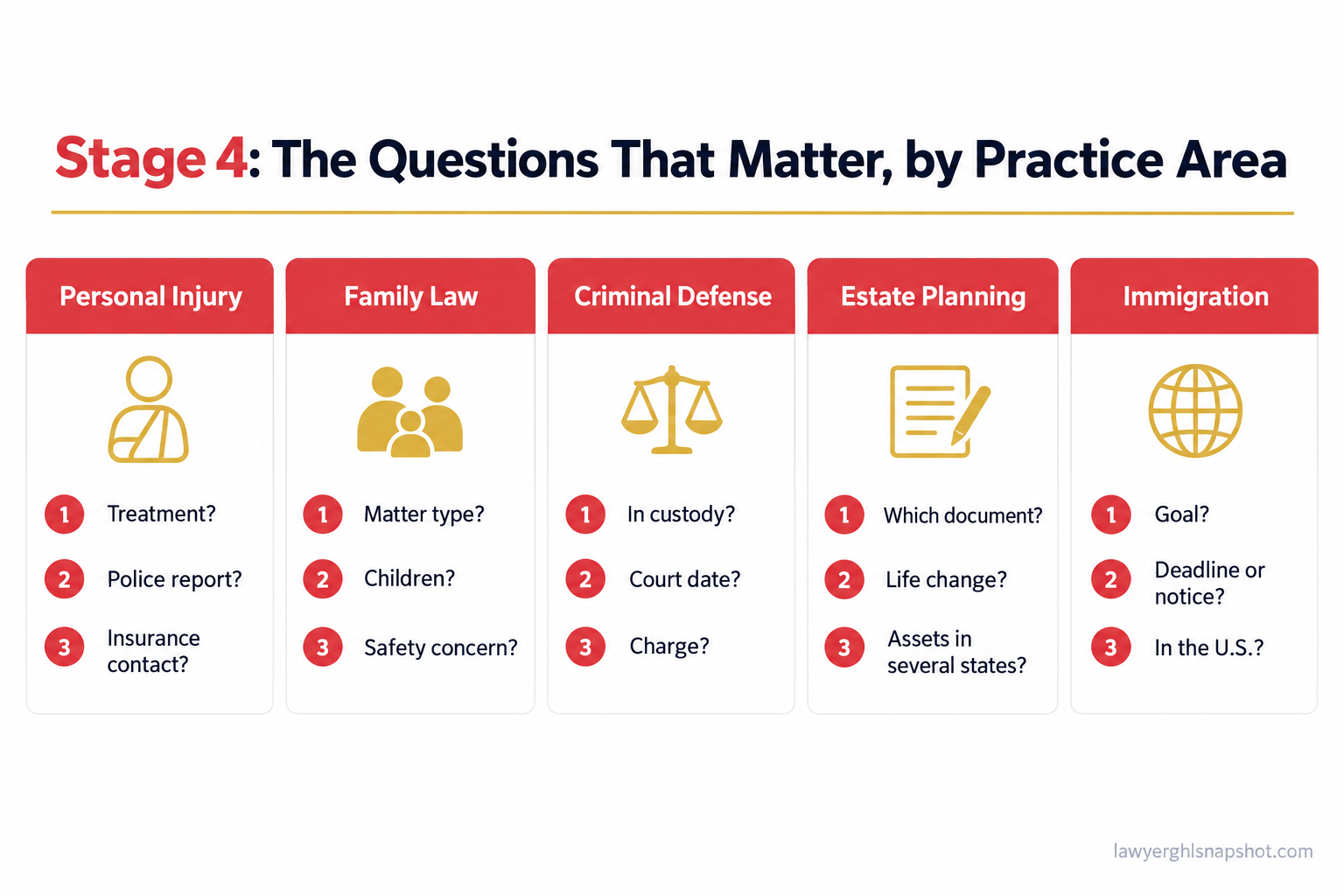
Personal injury intake script
PI is a speed game: the caller is shaken, sometimes at the scene, shopping several firms. Lead with care, then capture the facts.
Family law intake script
Family callers are afraid, deciding whether they can trust you, so tone does more work than facts.
Criminal defense intake script
The most time-sensitive call you take, often from a family member, not the defendant.
The “don’t tell me the details” line keeps privileged facts out of a non-lawyer’s notes.
Estate planning intake script
Rarely a crisis, so this call runs slower.
Immigration intake script
Callers may be anxious about status, worried about cost, and more comfortable in another language. Confirm language first.
The follow-up scripts that book the consult
Most firms treat the call as the whole job. It is half. The other half is what happens when nobody answers or the caller says “let me think.” A missed-call text-back and a short cadence recover cases you earned. The messages, verbatim:
These work on two rules: speed, so the missed-call text goes out in under a minute, and a reminder cascade before the appointment, which is how you cut no-shows. For longer nurture, adapt them into follow-up email templates.
Solo, small team, and 15-attorney firm
The same six-stage script runs at every size. What changes is who runs it and how calls route.
The solo who answers their own phone. Every call you take is time off a matter you already bill at just 3.0 hours a day. Use the script for the calls you can take; put the missed-call text-back and voicemail on the rest. The goal is not to answer every call live, but that no caller hears silence.
The small team with a shared line. The risk is inconsistency: three people answer three ways and freelance the fee talk. Standardize on one printed script, one place to log the conflict-check name and matter facts, and one owner of follow-up each day. Our legal intake process guide covers the handoff from call to logged matter.
The 15-attorney firm with dedicated intake. Staff drift off-script under load. Route by practice area so the right script and calendar load automatically, review calls weekly, and automate the follow-up.
How intake calls break, and how to fix each one
The scripts are the easy part. Calls die in predictable ways. Each failure mode and its fix:
The call is never answered. The biggest leak. Fix: three rings during hours, a missed-call text-back within 60 seconds outside them.
The intake person talks too much, filling silence with quasi-legal opinions. Fix: the script front-loads listening and hard-codes the “I can’t give legal advice” line.
No conflict check. You bond for fifteen minutes, then turn the caller away because you represent the other side. Fix: get the opposing party’s name in stage 3, before the facts.
The fee talk gets fumbled, or no time gets booked. “It depends” and “call us back to schedule” are where cases die. Fix: say your model in one plain sentence, offer two named slots, book on the call, confirm by text.
No follow-up. The caller says “let me think,” and nobody texts again. Fix: the automated three-message cadence above. Remember, 64% of prospects get nothing.
The compliance lines you cannot skip
Intake is where marketing rules and ethics rules collide, and the mistakes are expensive. None of this is legal advice, confirm your own state’s rules, but here is what constrains every firm.
Model Rules 7.1, 7.2, and 7.3. Communications cannot be false or misleading (Rule 7.1), so no outcome promises. Rule 7.2 lets you pay a lead generator only if it does not recommend or vouch for you, and never permits sharing fees with non-lawyers, which is why “slice of every case” vendor pitches are a problem. Rule 7.3 restricts live solicitation: answering an inbound call is fine, cold-dialing accident victims is not.
The AI and chatbot rule. An AI or bot handling intake must disclose it is not an attorney and stick to routing and scheduling. The moment it answers “what are my chances,” you risk the unauthorized practice of law and muddy privilege. We cover this in law firm texting and AI chatbot compliance. AI captures and books, humans advise.
TCPA and your follow-up texts. The one that generates class actions. Marketing texts require prior express written consent, with statutory damages of $500 to $1,500 per message (FCC / TCPA). Once texts turn promotional you need documented opt-in and a clear “reply STOP” you honor instantly, which is why every template above ends with an opt-out. Texting from a 10-digit number also requires A2P 10DLC registration. State advertising rules vary too (Florida files most paid ads 20 days before use, Texas within 10 days after), so check your jurisdiction before you automate outreach.
Common objections
“Scripts sound robotic.” A bad one does. A good script is a checklist, not a monologue, and winging every call is what actually sounds inconsistent.
“I don’t have time to answer every call.” You do not have to. The missed-call text-back and voicemail mean a call you cannot take gets a reply in under a minute, and a legal virtual assistant can run the live script for you.
“Won’t automated texts annoy people, or get me sued?” Only if you do it wrong. Responding to someone who contacted you, with a clear opt-out, is nothing like a cold blast. Keep it to three messages, include “reply STOP,” and honor opt-outs instantly.
“I already pay for Clio or an answering service.” Case-management software organizes matters you already signed; it does not answer your phone at 7pm. Answering services take a message but rarely run a practice-area script or book your calendar. The script and the speed are what convert, and that layer need not be rented per seat.
Frequently asked questions
What should a law firm intake script include?
Six stages: a fast, warm greeting; acknowledgment of the situation; a conflict and fit check (get the opposing party's name); the two or three matter facts that decide the case; a plain-language fee explanation; and a specific appointment confirmed by text. It should also state that the intake person is not an attorney and cannot give legal advice.
How fast should I respond to a new legal lead?
As close to immediately as possible. Contacting a lead within five minutes instead of thirty makes you roughly 100 times more likely to reach them and 21 times more likely to qualify them (InsideSales / MIT). Answer live in three rings, and fire a missed-call text-back within 60 seconds when you cannot.
Can a non-lawyer do intake calls?
Yes, and most firms do exactly that. The limit is legal advice: intake staff can gather facts, explain fees, and schedule, but cannot assess the merits of a case or predict outcomes. That is why the script hard-codes a 'we cannot give legal advice' line and routes legal questions to an attorney.
Are follow-up texts to prospective clients legal?
Responding to someone who contacted you is generally fine. Promotional texts require prior express written consent under the TCPA, with statutory damages of $500 to $1,500 per message. Always include a clear opt-out ('reply STOP'), honor stop requests immediately, and register for A2P 10DLC.
Should I use an AI chatbot for intake?
AI is excellent for capturing details and booking 24/7, which is where most leads are lost. It must disclose it is not an attorney and should route or schedule, not answer legal questions like 'what are my chances,' which risks unauthorized practice of law and privilege problems. Let AI capture and book; let humans advise.
Back to that Thursday call
The woman in the urgent care parking lot is still deciding. If your line rang out, she is already talking to the next firm. If someone picked up in three rings, reassured her, got her details, and booked her for tomorrow at 2pm with a confirming text on the way, she is done shopping. Same caller, same case, same firm. The only difference: somebody had the words ready.
That is all a script is: the words, ready, before the phone rings. Print the page for your practice area, put the missed-call text and follow-ups on autopilot, and say the conflict-check and no-advice lines every time. Do that and you out-convert most of your market, because most of it still lets two of three callers walk away in silence.