It is 4:50 on a Thursday and your phone is on silent in a courthouse hallway. It buzzes. Someone rear-ended two hours ago is calling the number at the top of their Google search, which happens to be you. You cannot pick up. The call rolls to voicemail, they do not leave one, and they tap the next firm on the list. By the time you reach your car, that case belongs to someone else.
That is the whole problem with running intake as a solo. You are the attorney, the receptionist, the biller, and the marketing department at once. The fix is not to work the phones harder, it is a system that captures, answers, screens, and books every lead while you do the legal work. Below is that system, built for a one-person shop, with the message copy you can steal and the compliance rules that keep it clean.
Key Takeaways
- The phone is where solos lose the most. In a test of 500 firms, only 40% answered a prospective client’s call and 20% of missed calls were returned (Clio 2024 Legal Trends Report, via ABA).
- A missed call is not a lost lead if something answers. An instant text-back, a form reply, and a booking link catch the inquiry even when you are in a hearing.
- Speed decides it. Across industries, a five-minute response made a lead 21 times more likely to qualify than a thirty-minute one (Harvard Business Review). You cannot hit that by hand; automation can.
- The same six stages scale from a true solo to a three-attorney firm.
Table of contents
- Why solo intake breaks, and what it costs
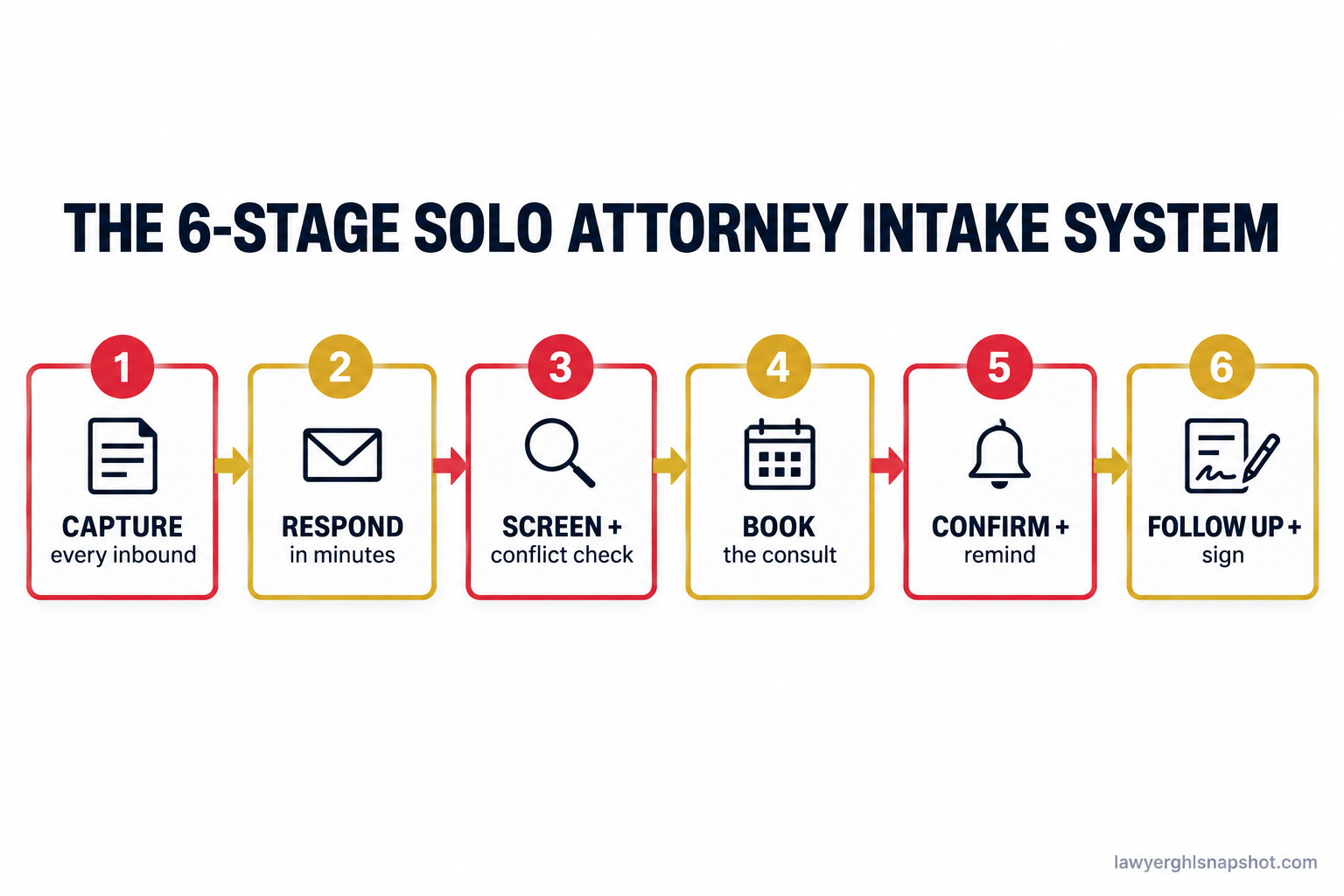
- The 6-stage solo intake system
- Build it yourself, hire it out, or automate it?
- The same system for a solo, a solo plus VA, and a 3-attorney firm
- The compliance rules that keep your license
- Common objections
- Frequently asked questions
Why solo intake breaks, and what it costs
Intake breaks because you are one person, and it demands an instant response at the moment you are least available. The good leads call during business hours, exactly when you are in court, so they go to voicemail, and voicemail is where new clients go to die. In Clio’s 2024 secret-shopper study of 500 firms, only 40% answered a prospective client’s call, down from 56% in 2019, and nearly half were unreachable by phone (2Civility, Illinois Commission on Professionalism). The second failure is silence after first contact: only about one in three firms replied to an email inquiry, and 64% of prospective clients received no follow-up at all (Oklahoma Bar Journal).
Share of firms taking each action with a prospective client, from a secret-shopper study of 500 U.S. law firms (Clio 2024 Legal Trends Report, via ABA Law Practice). Every gap is a prospect who found a lawyer elsewhere.
For a solo, that is a calendar problem, not negligence. You meant to call back, you got buried, the lead is gone. Put a dollar figure on it: if you get 40 new inquiries a month and recover only half, the two or three real cases among the 20 you lose are the ones that hurt. The compounding cost is your time. Clio’s benchmarks put the average lawyer’s utilization at 38%, about three billable hours in an eight-hour day (Clio Legal Trends benchmarks), so every hour on phone tag is stolen from the three that pay. A system fixes both by responding the instant a lead arrives and following up until you take over.
The 6-stage solo intake system
The six stages run the same whether a lead calls, fills out a form, or texts. Each stage has a job, a piece of copy you can steal, and a way it breaks when you run it by hand. Build it once and it runs every day you are unreachable.
Stage 1: Capture every inbound, on every channel
The first job is simple: nothing gets dropped. A missed call triggers an instant text, a form fill gets an immediate reply, and website chat routes to the same place. The anchor is missed-call text-back: when a call rings out, the system texts the caller in seconds, so the conversation starts before they dial the next firm. See the missed-call text-back playbook for the mechanics.
The failure mode is partial coverage. Set up the missed call but leave the web form or after-hours gap uncovered, and a 9pm submission that hears nothing until Monday is just as lost. Cover every channel and every hour, or the leak just moves.
Stage 2: Respond in minutes, not hours
Capture bought a few minutes; Stage two uses them. Analyzing thousands of leads across industries, a five-minute response made a lead 21 times more likely to qualify than a thirty-minute one (Harvard Business Review). That study was not law-specific and measured qualifying, not signing, so treat five minutes as a target, but the firm that engages first usually wins the consult, as our speed-to-lead guide explains. For a solo, five minutes by hand is impossible mid-hearing, so the first reply is automated and the handoff to you is not.
The failure mode is the manual callback that never happens. You mean to call at lunch, lunch becomes a working lunch, and the lead signs with the firm that texted back in ninety seconds. Automate the sequence so your good intentions are not the point of failure.
Stage 3: Screen and run the conflict check
A solo cannot spend scarce hours on matters outside your practice or carrying a conflict. Stage three sorts prospects before they hit your calendar. Build a short qualifying set into the flow: what kind of matter, where and when it happened, and the one or two facts that decide fit. Capture the names you need to run a conflict check before you offer any advice.
The failure mode is screening too late. Book first and screen during the consult, and you have burned a slot on a matter you were always going to decline.
Stage 4: Book the consult without phone tag
A qualified lead forced to call back during business hours to schedule is one you can still lose. Stage four removes the back-and-forth with a live booking link that shows your real availability and lets the prospect pick a slot fast. Put the link in the first text, the form confirmation, and every follow-up, and hold the slot the moment they book. The failure mode is the “call us to schedule” dead end: every extra step between interested and booked leaks prospects, and the worst step for a solo is the one asking them to reach you by phone, the channel that already failed them.
Stage 5: Confirm and remind so they actually show up
A booked consult is not a kept consult. Solo calendars are brutal on no-shows, because the prospect who booked at 11pm in a panic has calmed down by morning. Stage five protects the slot with a short cascade: a confirmation when they book, a reminder the day before (“a reminder of your consultation with [Firm Name] tomorrow at [time]. Need a different time? Reschedule here: [link]”), and one a few hours out, each with an easy path to reschedule instead of ghost. A prospect who moves the appointment is still your client; one who does not show is usually gone. For the full cascade and timing, see how to reduce law firm no-shows.
The failure mode is treating the booking as the finish line. Without reminders a meaningful share of consults evaporate, and every empty slot is an hour you could have billed.
Stage 6: Follow up, sign, and stay in touch
The consult happened. Now the matter either signs or sits, and Stage six moves it off the fence. Within a few hours, the system sends the engagement agreement and fee information (“Great speaking with you today about your [matter type]. Here’s the agreement and next steps: [link]. Once that’s signed we can get started right away.”), follows up if it is not signed in a day or two, and drops the not-ready prospects into a slow, low-touch nurture so you stay top of mind. The same tooling runs database reactivation for clients and leads who went cold. The failure mode is the fence-sitter you never contact again: most who do not sign on the spot are a not yet, not a no, and a solo with no nurture loses them to whoever does follow up.
Build it yourself, hire it out, or automate it?
You have three honest ways to cover intake, and each fits a different stage of practice.
Three ways a solo can cover intake (2026)
| Plan | Do it yourself | Answering service | Automated system recommended |
|---|---|---|---|
| Price | $0 + your time | $1 to $3 / call | flat monthly |
| Feature 1 | Free, you control every word | A human answers after hours | Capture, screen, book, remind in one flow |
| Feature 2 | Works only when you're available | Good for a greeting and messages | Responds 24/7 on every channel |
| Feature 3 | Breaks when you're in court | Rarely screens, books, or follows up | Flat fee, not per call or seat |
| Feature 4 | Costs billable hours and lost leads | Generic scripts unless you pay more | You handle only human decisions |
An answering service is fine if you just need a human voice after hours, but most stop at taking a message. An automated system does the whole flow on a flat fee, not a per-seat legal CRM bill, which is the GoHighLevel approach for law firms. You can start a GoHighLevel trial yourself. (Disclosure: that is our affiliate link and we may earn a commission at no extra cost to you.)
The same system for a solo, a solo plus VA, and a 3-attorney firm
The six stages do not change with size. What changes is who touches each stage and how much automation earns its keep.
The true solo. Your enemy is your own calendar, and automation is the only way the phones get covered while you work. Lean hardest on Stages 1 and 2 so no lead waits on you being free, and let the booking link and reminders run the schedule. Ten minutes a day on the intake queue is the whole management job.
The solo plus a part-time VA. Keep the instant, after-hours, and repetitive pieces automated, and point the VA at the human touches: reviewing screened leads, warm calls to the promising ones, the back-and-forth software should not handle. A virtual assistant works best on top of automation, not instead of it.
The three-attorney firm. Intake becomes a routing problem on top of a response problem. Leads must land with the right attorney, and someone has to own the pipeline so nothing sits. Add assignment rules, a shared pipeline, and light reporting on which sources sign. Three people relying on memory drop three times as many leads, so a documented legal intake process plus automation keeps it from leaking.
The compliance rules that keep your license
Automated intake touches texting, calling, and solicitation, rules that carry real penalties. Build it in from the start, not after a complaint. This is operations guidance, not legal advice, and the rules vary by state.
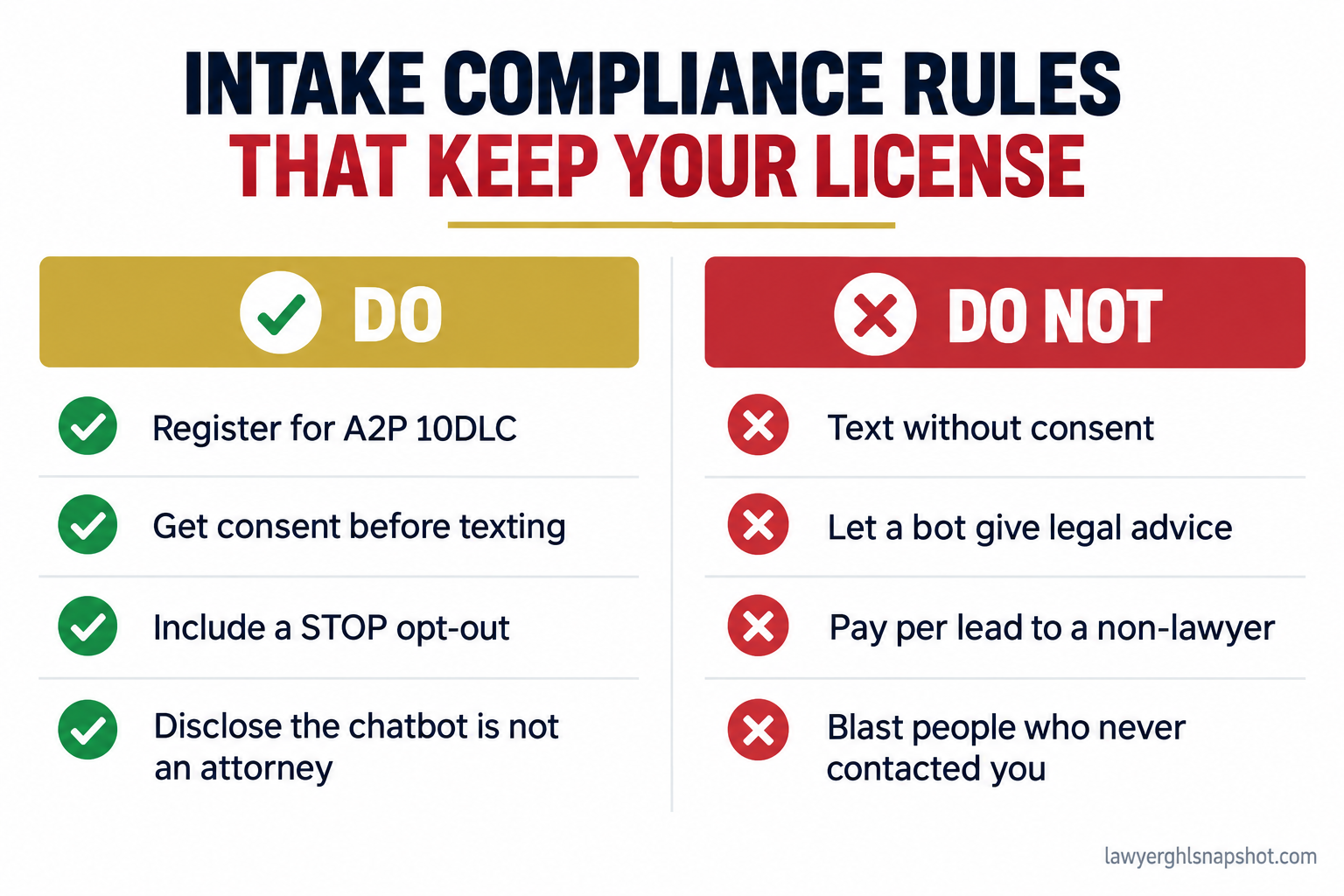
Register before you text. U.S. carriers require business texting to be registered through the A2P 10DLC system, with a verified brand and campaign filed through The Campaign Registry. Unregistered traffic on a standard number gets blocked, so it is not optional if your intake runs on SMS, and registration takes a week or two.
Get consent, and keep informational separate from marketing. The conservative standard under the TCPA is prior express written consent for marketing texts, with a lighter one for transactional messages like an appointment reminder. Courts have been shifting the exact line, so capture clear consent when a prospect contacts you, keep the record, include a STOP opt-out, and honor it immediately. See our texting and AI chatbot compliance guide for the consent language.
Your chatbot is not a lawyer, and it must say so. An AI intake assistant should disclose it is not an attorney and should route, screen, and schedule, not answer “what are my chances.” A bot that opines on the merits risks the unauthorized practice of law.
Mind advertising and solicitation. Your intake messages are communications about your services: ABA Model Rule 7.1 bars false or misleading claims, and Rule 7.3 limits soliciting someone who did not reach out first. Automated follow-up to a person who contacted you is fine; blasting people who never raised a hand is not. And if a vendor offers to sell you leads for a cut of fees, stop: Rule 7.2 and the broad ban on fee-sharing with non-lawyers make that a problem in most states. Confirm the wording in your jurisdiction first.
Common objections
“Won’t an automated text feel cold and push people away?” Usually the opposite. A prospect who just hit voicemail expects nothing, so a warm text in ten seconds feels like a firm that has its act together. AI adoption in law is still early, with about 30% of attorneys’ offices using AI tools in 2024 (ABA 2024 AI TechReport), so a fast, polished response still sets you apart.
“I already pay for Clio or MyCase.” A case manager runs matters you have signed, not leads you have not. If your tool has a working intake pipeline and you use it, run the system there. Most firms pay for the capability, never switch it on, and still lose the after-hours lead.
“I’m not technical, this sounds like a project.” The hard part is not the software, it is deciding the rules once: what the text says, who gets screened out, what your calendar offers. The build is a one-time setup, done for you if you want, and then it runs without you. You do not maintain it, you review a queue.
Frequently asked questions
What is a client intake system for a solo law firm?
A connected set of automations that capture, respond to, screen, and book every new lead, even when the attorney can't pick up. The core pieces are missed-call text-back, an instant first reply, a screening flow, an online booking link, reminders, and post-consult follow-up. Solos miss the most calls: in a study of 500 firms, only 40% answered a prospective client's call (Clio 2024 Legal Trends Report, via ABA).
How fast do I really need to respond to a new lead?
As close to immediately as you can. Across industries, responding in five minutes instead of thirty made a lead 21 times more likely to qualify (Harvard Business Review). That research measured qualifying, not signing, so treat five minutes as a target. A solo can't hit it by hand while in court, which is why the first response is automated and the handoff to you is not.
Do I need GoHighLevel or can I use my existing legal CRM?
Either can work. A case manager like Clio or MyCase runs matters you've signed and sometimes includes an intake pipeline. A flat-fee platform like GoHighLevel is built for the capture-respond-book-remind flow and doesn't charge per seat. The deciding factor is whether your current tool does instant, multi-channel response, and whether you've turned it on. Most firms haven't.
Is it legal to text prospective clients automatically?
Yes, with guardrails. U.S. carriers require A2P 10DLC registration through The Campaign Registry before you send business texts, and the TCPA requires consent, with written consent the conservative standard for marketing and a lighter one for transactional texts like reminders. Always include a STOP opt-out and honor it. Rules vary by state. This is operations guidance, not legal advice.
Can an AI chatbot give legal advice during intake?
No. An intake chatbot must disclose that it is not an attorney and should only gather facts, screen, and schedule. Letting a bot answer 'what are my chances' risks the unauthorized practice of law. Keep it to routing and booking, and bring the attorney in for anything about the merits.